Match Your Resume to a Job Posting: How to Increase Your Chances of Getting the Job (2026 Guide)
Match your resume to a job posting and see how well you fit the role. Get a match score and actionable AI suggestions to improve your resume.
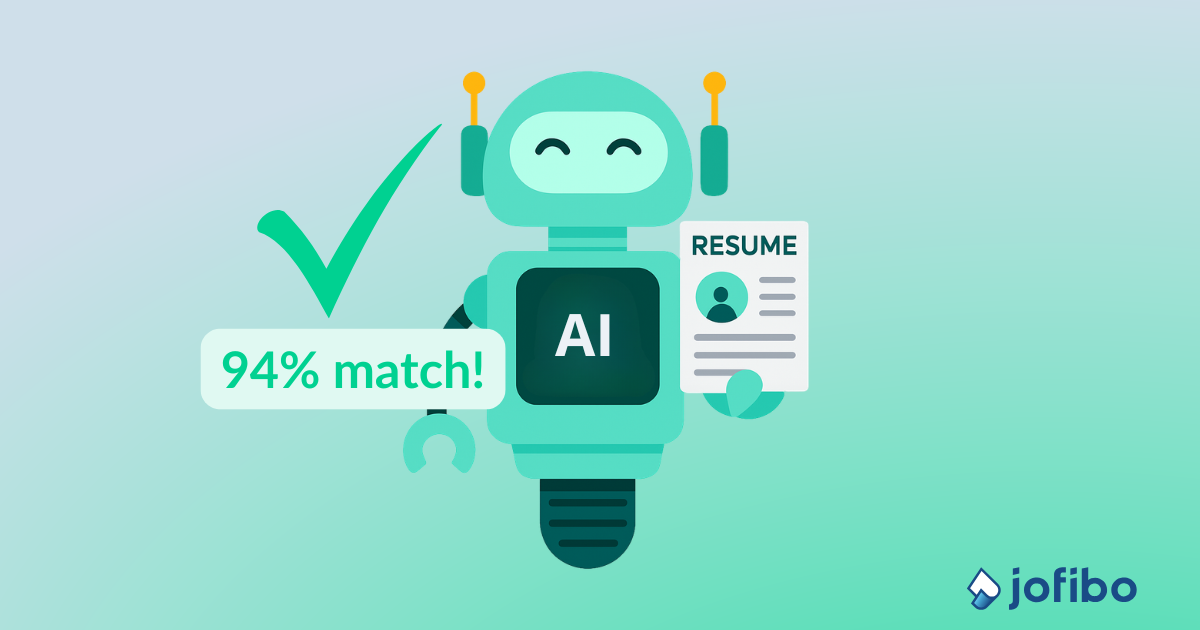
Writing a strong resume isn’t just about describing your experience. It’s about showing that you align with the specific job you’re applying for.
Many job seekers are qualified but still get rejected because their resume doesn’t clearly reflect the requirements in the job posting. They send the same resume to multiple roles, even though a recruiter’s evaluation often depends on how clearly the match is presented.
This is one of the biggest mistakes in modern job searching.
In this guide, you’ll learn:
- How to match your resume to a job posting
- Why most resumes get rejected
- How to use AI to improve your match
- How to increase your chances of getting an interview
This guide is relevant for anyone who wants to tailor their resume more precisely and understand why some applications lead to interviews while others are overlooked.
What Does It Mean to Match a Resume to a Job Posting?
Matching a resume to a job posting means aligning your skills, experience, and wording with the requirements outlined by the company.
The clearer your match, the higher your chances of being invited to a job interview.
TL;DR: How to Match Your Resume to a Job Posting
- Identify key requirements in the job posting
- Compare them with your skills
- Tailor your resume to the specific role
- Highlight relevant achievements
- Use AI to analyze and improve your match
If you already have a resume in Word or PDF, you don’t need to start from scratch. You can import your existing resume into Jofibo and get an analysis in seconds.

Why Doesn’t Your Resume Match the Job Posting?
Most resumes are rejected within 10–20 seconds. Not because the candidate is unqualified, but because the resume doesn’t clearly show alignment with the job.
Common reasons why your resume doesn’t match the job:
- Your resume is too generic
- Key skills are not highlighted
- Keywords from the job posting are missing
- Your experience is not tailored to the role
A resume that isn’t tailored to the job posting is often rejected in the first screening, even if the candidate is relevant. Avoid this frustrating situation by checking how well your resume matches the job posting.
What Do Recruiters and ATS Systems Evaluate When Reading Your Resume?
Matching a job posting means your resume clearly demonstrates that you can perform the specific tasks required in the role using the skills, experience, and results the company is looking for.
It’s not just about having the right qualifications. It’s about making them visible and expressing them in the same context and language as the job posting.
Recruiters and ATS (Applicant Tracking Systems) typically evaluate your resume based on three key criteria:
- Relevance: Do your skills and experience match the requirements in the job posting?
- Clarity: Is it easy and quick to see that you are a relevant candidate?
- Proof: Do you support your skills with concrete results?
If your resume doesn’t score highly on these three parameters, you risk being rejected—even if you are qualified.
When assessing whether your resume matches a job posting, focus on three main areas: technical skills, soft skills, and documented results.
Hard Skills (Technical Skills)
Hard skills are specific, measurable competencies that are often listed directly in job postings.
Examples of hard skills in a job posting:
- Excel
- Project management
- SQL
- Marketing automation
These skills are often used as search criteria in ATS systems, meaning your resume may be filtered out if they are not clearly stated.
Soft Skills (Personal Skills)
Soft skills describe how you work, collaborate, and communicate.
Examples of soft skills from a job posting:
- Collaboration
- Communication
- Organization
- Problem-solving
Many candidates mention soft skills but fail to document them effectively in their resume. To strengthen your match, connect your soft skills to specific situations or results. You can use the STAR method to describe your work experience.
Example of describing soft skills:
- Generic: “Good at collaboration”
- Strong: “Collaborated with 5 departments to implement a new CRM system”
Experience and Results (The Decisive Factor)
It’s not enough to describe your responsibilities. What matters is what you achieved. Recruiters are looking for candidates who create value—not just perform tasks.
Example of showing value:
- Generic: “Responsible for marketing campaigns”
- Strong: “Planned and executed campaigns that increased leads by 35%”
When you present your results this way, your resume becomes more credible, more concrete, and more relevant. Read our full guide: How to Write a Resume.
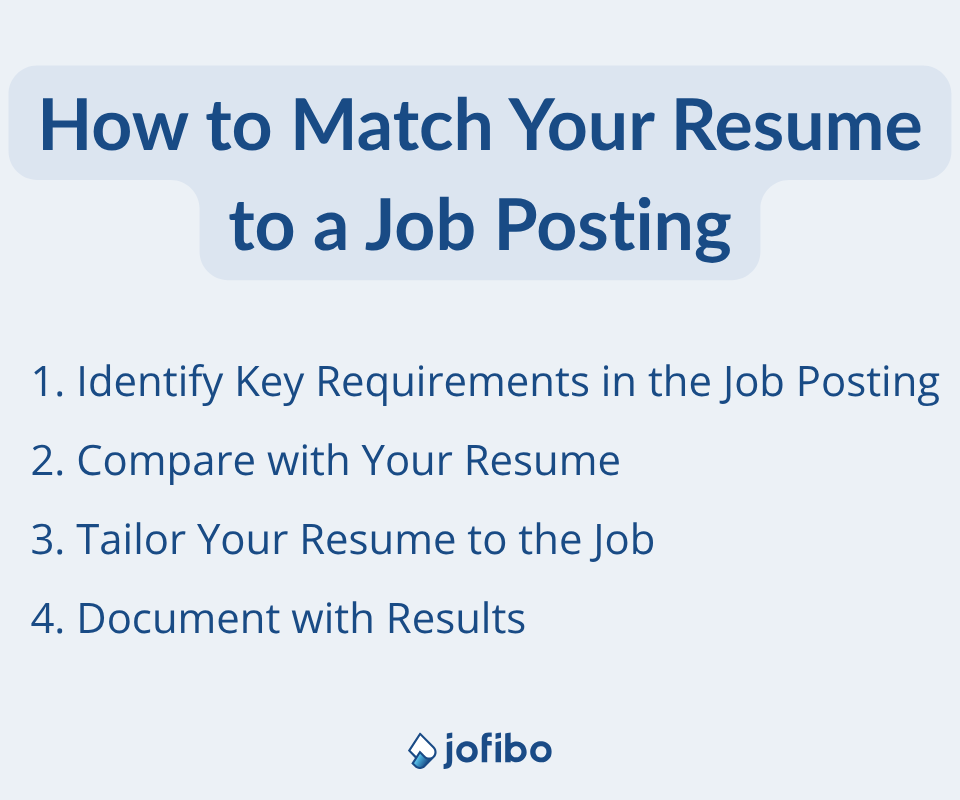
How to Match Your Resume to a Job Posting (Step-by-Step)
Matching your resume to a job posting is a systematic process—not something you should rely on intuition for. The most successful candidates actively translate the job posting into their resume, making it clear to both recruiters and ATS systems that they are a strong match.
Here’s the method you should follow:
1. Identify Key Requirements in the Job Posting
Start by analyzing the job posting carefully. Your goal is to understand what the company is truly looking for—not just on the surface, but in detail.
Focus on:
- Repeated words and phrases (e.g., “data analysis,” “project management,” “stakeholder management”)
- Requirements vs. preferences (what is “must-have” vs. “nice-to-have”)
- Specific tools and systems (e.g., Excel, Salesforce, Google Analytics, SQL)
2. Compare with Your Resume
Once you’ve identified the requirements, compare them with your resume.
Ask yourself:
- Do I have these skills or experiences?
- Are they clearly visible in my resume, or are they hidden?
- Are they placed in the right sections (top vs. bottom)?
A common mistake is having the right skills but not presenting them clearly enough.
Example:
You have worked with data analysis, but it’s only mentioned briefly in a long job description. In the job posting, it’s a key skill—so in your resume, it should be highlighted more prominently.
Your resume shouldn’t reflect everything you’ve done. It should reflect what’s most relevant to the job.
3. Tailor Your Resume to the Job
Once you know what matters, actively tailor your resume. Focus especially on language and prioritization. Use the same terminology as in the job posting.
For example, if the posting says “stakeholder management,” don’t write “collaboration with stakeholders.” Write “stakeholder management.”
Small differences in wording can have a significant impact—especially in ATS systems that scan for specific keywords.
4. Document with Results
The final—and most important—step is documenting your impact in your work experience. Recruiters don’t just look at what you’ve done. They look at what you’ve achieved.
Whenever possible, support your experience with:
- Numbers
- Percentages
- Concrete results
What If You Can’t Measure Your Results with Numbers?
Not all roles provide access to concrete metrics or KPIs. That doesn’t mean you can’t demonstrate your impact. Recruiters still evaluate your value—you just need to make it visible in other ways.
Here are four effective methods:
1. Describe Your Direct Impact
Instead of numbers, explain what changed because of your work.
“Participated in implementing a new system”
Becomes:
“Helped implement a new system that made workflows more structured and efficient”
“Worked with onboarding”
Becomes:
“Contributed to improving the onboarding process so new employees could get up to speed faster”
Focus on: improvement, efficiency, structure, and quality.
2. Describe Scope and Responsibility
If you don’t have numbers, show the scale and complexity of your work.
- “Responsible for coordination across multiple departments”
- “Worked closely with leadership and external stakeholders”
- “Handled multiple tasks simultaneously in a fast-paced environment”
This gives a clear indication of level and responsibility.
3. Use Concrete Examples and Cases
You can demonstrate your value by describing specific situations you’ve handled.
“Good at problem-solving”
Becomes:
“Resolved an issue with delayed deliveries by optimizing planning and improving team visibility”
Recruiters love concrete examples—they make your skills more credible.
4. Use Feedback and Recognition
If you don’t have numbers, show value through feedback from others.
- “Received positive feedback for my structure and organization”
- “Often acted as a sparring partner within the team”
- “Recognized for building strong customer relationships”
Do you already have a resume but aren’t sure how well it matches a job?
Import it into Jofibo and get a clear analysis of strengths, gaps, and improvement opportunities.
The Biggest Mistake Job Seekers Make
The biggest mistake many job seekers make is reusing the same resume for every application. It may seem efficient—but it rarely is. A generic resume almost always appears less relevant because it isn’t tailored to the specific role. The result:
- Lower relevance in the eyes of recruiters
- Lower match in ATS systems scanning for specific keywords
- Fewer interviews—even if you are qualified
The problem is not necessarily your skills or experience. The problem is that they are not presented in the right context. Instead of seeing your resume as a static document, you should treat it as a tool that is continuously tailored.
Recruiters don’t just evaluate whether you can do the job—they evaluate whether it’s clear that you fit this specific role. Hiring the wrong candidate is costly, so companies often choose candidates where the match is obvious from the start.
Why Generic Resumes Get Rejected
A standard resume often tries to cover everything:
- All previous experience
- All skills
- All types of jobs
But for a recruiter, this means:
- It’s harder to identify relevance
- It takes more time to find key information
- It creates doubt about how well you match the role
In practice, recruiters often choose candidates where the match is clear at first glance.
How AI Can Help You Match Your Resume to a Job Posting
In short, AI helps you see your resume through the eyes of a recruiter—before you send your application.
This is valuable because manually matching a resume to a job posting requires time, structure, and experience. You need to understand what the company is asking for and evaluate whether your skills and wording are clearly reflected in your resume.
Even small differences in language, prioritization, and structure can significantly impact how your resume is evaluated. That’s where AI makes a difference: it helps you quickly identify where your resume matches well—and where it can be improved.
Instead of guessing, AI allows you to perform a systematic and objective analysis of your resume against a specific job posting. You can:
- Analyze your resume and identify your skills, experience, and wording
- Compare it directly with the job posting to find matches and gaps
- Identify missing elements such as key skills or relevant keywords
- Receive concrete suggestions to make your resume more targeted
Additionally, AI can help you:
- Prioritize your most relevant experience
- Adapt your language to match the job posting
- Make your wording clearer and more results-oriented
The advantage of AI is speed and precision. While a manual review can take 30–60 minutes, AI can provide a qualified assessment in seconds.
This also applies to your cover letter and job interview preparation
Match Your Resume with a Job Posting Automatically with Jofibo
With Jofibo, you can automatically match your resume with a job posting and get a clear evaluation of how strong your match is. The feature is designed to help you move from a generic resume to a targeted resume that fits the specific role.
Here’s how it works:
- Open your resume or import it into Jofibo
- Paste the job posting into the AI module “Match with Job Posting”
- Select language
- Get an AI analysis instantly
Within seconds, you’ll receive a structured evaluation of your resume. You’ll get:
A match score
→ shows how well your resume fits the role
What works well
→ which parts of your resume already match the requirements
What can be improved
→ concrete suggestions to strengthen your resume
Which skills are missing
→ so you know what to highlight or add
In other words, Jofibo allows you to see your resume through a recruiter’s perspective—and adjust it before sending your application.
What Does Your Match Score Mean?
Remember, the match score is an indicator—not a final verdict. You don’t need 100% to be a strong candidate. In practice, many relevant candidates fall into these ranges:
- 60–75%: A solid starting point, with room for improvement
- 75%+: A strong match
- 90%+: A highly targeted resume
A lower match score doesn’t necessarily mean you’re not relevant. It usually indicates that your resume can be better aligned so your skills and experience are clearer to both recruiters and ATS systems.
What matters most is not the number itself—but the insight behind it and how you use it to improve your resume.
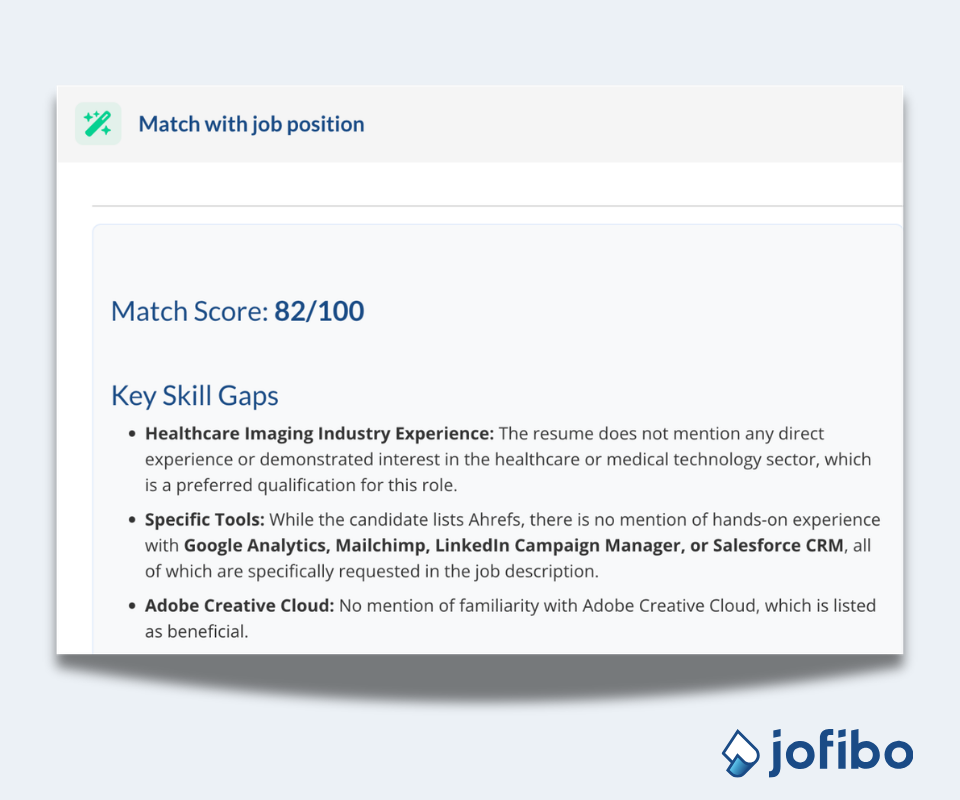
Example of a Resume Match Analysis
To make this more concrete, let’s look at an example. Imagine you’re applying for a role as a marketing specialist, where the job posting emphasizes:
- Performance marketing
- Data analysis
- Marketing automation
- Cross-channel campaign execution
You match your resume with the job posting and receive the following analysis:
Match score: 68%
This indicates that you are a relevant candidate—but there are clear areas where your resume can be strengthened to improve your chances.
What Works Well
- Experience with planning and executing campaigns
- Knowledge of social media and content marketing
- Relevant educational background in marketing
Your resume shows a solid understanding of marketing and practical experience with key responsibilities in the role.
What Is Missing or Underrepresented
- Marketing automation (e.g., HubSpot, ActiveCampaign, or similar)
- Data analysis and tools like Google Analytics
- Documentation of performance and results
This doesn’t necessarily mean you lack these skills—it means they’re not clearly visible in your resume.
Concrete Improvement Suggestions
- Add experience with tools (e.g., “used Google Analytics to analyze traffic and behavior”)
- Highlight campaign results (e.g., “increased engagement by 25%”)
- Adjust wording to match the language in the job posting
- Prioritize the most relevant experience higher in your resume
What Can You Use the Analysis For?
This type of analysis allows you to:
- Identify exactly where your resume falls short
- Focus your improvements where they matter most
- Increase your match without rewriting your entire resume
Instead of guessing, you get a clear foundation for optimizing your resume. With the right adjustments, you can significantly improve your resume—and increase your chances of getting an interview.
This is what a real match analysis can look like in practice.
Ready to Improve Your Resume?
Stop guessing whether your resume matches the job. Start with your current resume, import it into Jofibo, and get actionable improvements in seconds.
Or use our resume templates to get started quickly and for free

![Follow Up Email After a Job Interview [Examples 2026]](https://jofibostorage.blob.core.windows.net/blog/Follow-up-email-after-job-interview.png)