How to Use ChatGPT to Prepare for a Job Interview
Being invited to a job interview is a strong signal that your application has already done its job. Your resume, cover letter, and relevant skills have convinced an employer that you may be a good fit for the role. Out of dozens—or sometimes hundreds—of applicants, you have made it to the next stage of the hiring process.
Now comes the part that ultimately determines whether you receive a job offer: the interview.
How do you prepare effectively? What questions are employers likely to ask? How do you answer behavioral questions with confidence? And how can you stand out from other qualified candidates?
For many job seekers, interviews are the most stressful part of the hiring process. The pressure to perform, think quickly, and communicate your value can feel overwhelming. However, interview success is rarely about having the perfect answer. More often, it comes down to preparation.
In 2026, AI tools such as ChatGPT have become valuable interview preparation assistants for job seekers around the world. Used correctly, ChatGPT can help you anticipate interview questions, strengthen your answers, practice realistic interview scenarios, and identify areas for improvement before you ever speak to a recruiter.
Beyond interview preparation, ChatGPT can also assist with optimizing your resume and creating a good cover letter. In this guide, you'll learn how to use ChatGPT strategically to prepare for interviews, build confidence, and improve your chances of landing the job.
TL;DR: Using ChatGPT for Interview Preparation
While ChatGPT can help you prepare more effectively, it should not replace your own experiences, achievements, and personality. The strongest interview answers are always authentic, specific, and based on real examples from your career.
- Generate interview questions tailored to your target role
- Practice behavioral interview questions
- Improve answers using the STAR method
- Conduct realistic mock interviews
- Receive feedback on your responses
- Research companies and job roles
- Build confidence before the interview
- Avoid common AI-assisted interview mistakes
Used correctly, ChatGPT can function as a personal interview coach and help you approach your next job interview with greater confidence and preparation.
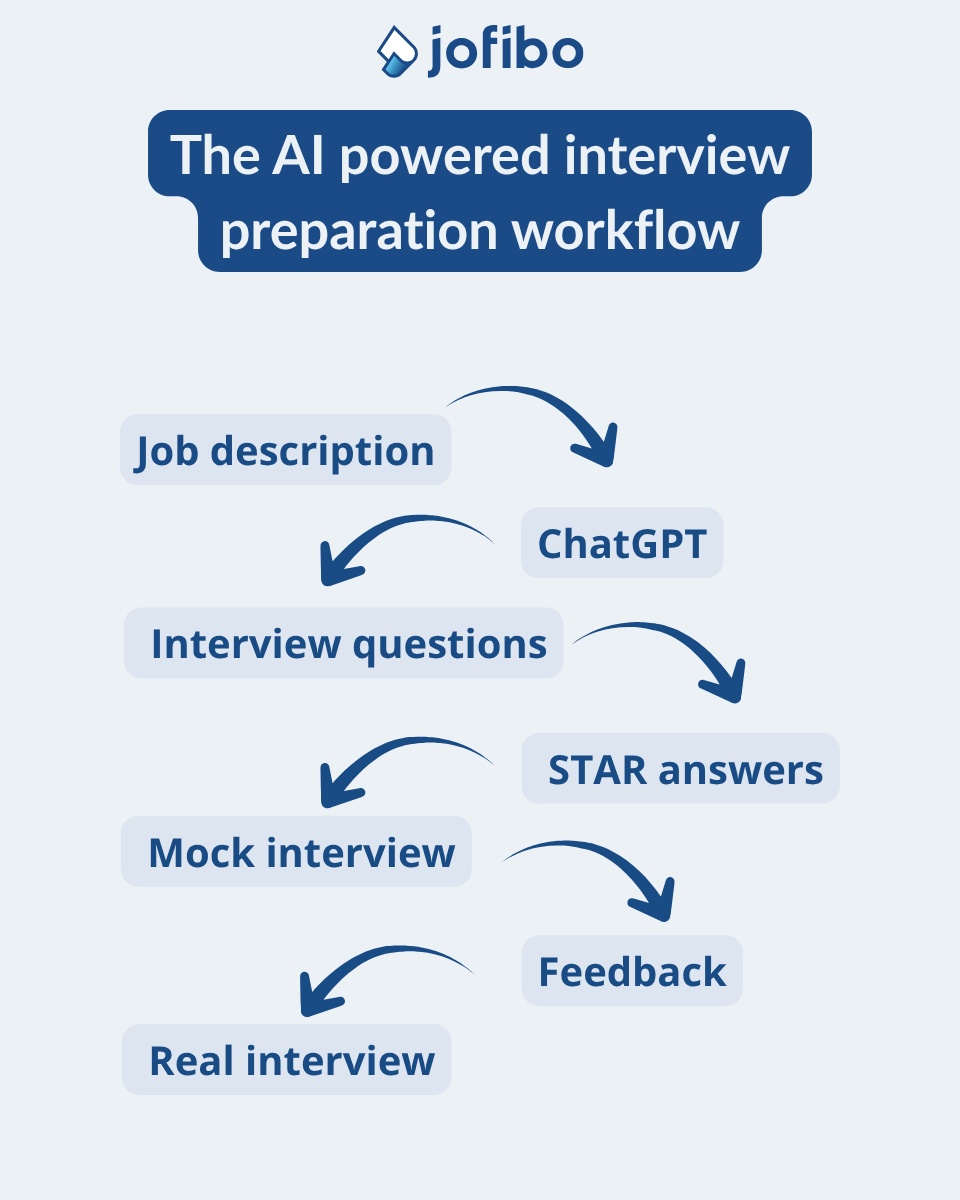
Can ChatGPT help you get a job?
Yes and no.
ChatGPT cannot get you hired, submit a successful interview on your behalf, or replace the qualifications and experience employers are looking for. Ultimately, hiring decisions are made by people who evaluate your skills, achievements, communication abilities, and fit for the role.
What ChatGPT can do is help you prepare more effectively.
Many job seekers use ChatGPT to practice interview questions, improve their answers, research employers, identify gaps in their experience, and build confidence before speaking with a recruiter. It can also help you communicate your achievements more clearly, structure behavioral answers using frameworks such as STAR, and explain complex experiences in a way that is easier for employers to understand.
This can be particularly valuable in today's hiring environment, where candidates often compete against hundreds of applicants and may encounter both recruiters and AI-powered screening systems throughout the hiring process.
However, ChatGPT should be viewed as a coach rather than a replacement for your own preparation. The most successful candidates use AI to refine and strengthen their responses, not to generate answers they simply memorize.
Your experience gets you considered. Your preparation gets you shortlisted. Your ability to communicate your value during the interview is what ultimately helps you get hired.
How AI is changing job interviews
Artificial intelligence is transforming the hiring process. What was once a largely manual process driven by recruiters and hiring managers now often involves multiple AI-powered tools before a candidate is ever invited to an interview.
Today, employers use AI to help identify qualified candidates, screen applications, assess skills, and streamline hiring decisions. As a result, job seekers need to prepare not only for conversations with recruiters but also for a hiring process that increasingly relies on technology.
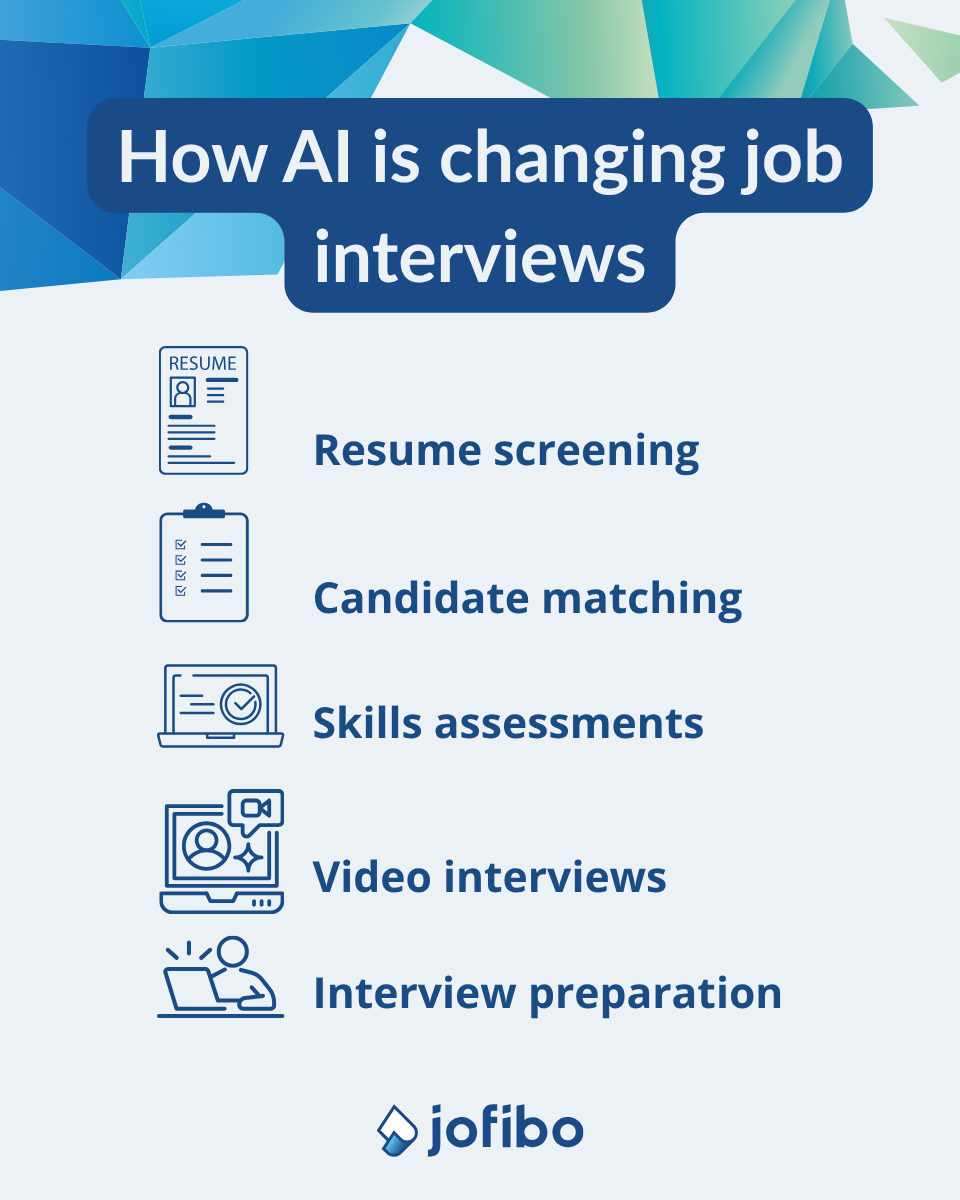
Some of the most common ways AI is used in recruitment include:
Resume screening
Many employers use Applicant Tracking Systems (ATS) and AI-powered screening tools to review resumes before they reach a recruiter. These systems analyze skills, experience, qualifications, and keyword relevance to determine whether a candidate matches the requirements of a role.
Candidate matching
Modern recruiting platforms use AI to compare a candidate's background against job requirements and rank applicants based on their suitability. This means that clearly communicating your skills, achievements, and experience has become more important than ever.
Skills assessments
Companies increasingly use AI-supported assessments to evaluate technical skills, problem-solving abilities, communication, and role-specific competencies. These assessments can influence whether a candidate progresses to the next stage of the hiring process.
Video interviews
Some organizations use AI-assisted video interview platforms that analyze responses, communication style, and interview performance. While human recruiters still make hiring decisions, technology often plays a role in the evaluation process.
Interview preparation
AI is not only changing how employers hire—it is also changing how candidates prepare. Tools such as ChatGPT can help job seekers research companies, generate interview questions, practice behavioral answers, conduct mock interviews, and receive feedback before meeting with a recruiter.
The rise of AI does not change what employers ultimately want: candidates who can demonstrate relevant experience, strong communication skills, and the ability to create value. However, understanding how AI is used throughout the hiring process can help you prepare more effectively and gain a competitive advantage in today's job market.
Ask ChatGPT for a list of typical interview questions
One of the biggest challenges in interview preparation is knowing what questions to expect. While there are many common interview questions, the reality is that every interview is different. The questions you are asked will vary depending on the company, industry, seniority level, and specific responsibilities of the role.
This is where ChatGPT can be particularly useful. By providing details about the position you are applying for, you can generate interview questions that are tailored to the role rather than relying on generic interview advice.
A more targeted preparation process allows you to focus on the skills, competencies, and experiences that employers are most likely to evaluate during the interview.
Use the following prompt:
"Act as a recruiter hiring for a [role]. Create 10 realistic interview questions and explain what the interviewer is trying to evaluate with each question."
Unlike a simple list of questions, this prompt helps you understand the reasoning behind each question. Knowing what the interviewer is trying to assess can help you prepare stronger, more relevant answers and identify examples from your own experience that demonstrate your suitability for the role.
The AI assistant will generate a list of interview questions that you can use to structure your preparation. If you want more variety, simply increase the number of questions, ask for role-specific scenarios, or request questions aimed at a particular experience level.
For example, you could ask for:
- Entry-level interview questions
- Senior management interview questions
- Technical interview questions
- Behavioral interview questions
- Industry-specific interview questions
You can also ask ChatGPT to regenerate the questions or create additional variations, helping you prepare for a broader range of interview scenarios.
Remember to ask for behavioral questions
Preparing for standard interview questions is a good starting point, but it is rarely enough to succeed in a competitive hiring process. Many employers place significant emphasis on behavioral interview questions because they provide insight into how a candidate has handled real situations in the past.
The principle behind behavioral interviewing is simple: past behavior is often one of the strongest predictors of future performance.
These questions are designed to evaluate competencies such as communication, teamwork, leadership, problem-solving, adaptability, conflict resolution, and decision-making. Rather than asking what you would do in a hypothetical situation, recruiters want to understand what you have actually done and what results you achieved.
This is why behavioral questions are commonly used in interviews across industries and experience levels.
To prepare for these questions, use the following prompt:
"Create a list of 10 realistic behavioral interview questions that could be asked during an interview for a [role]. Explain what competency each question is designed to assess."
Adding the second sentence significantly improves the quality of the output because it helps you understand the purpose behind each question. Instead of simply memorizing answers, you can focus on demonstrating the skills and competencies employers are looking for.
Behavioral questions often begin with phrases such as:
- Tell me about a time when...
- Describe a situation where...
- Give me an example of...
- How did you handle...
- Can you explain a situation in which...
These questions are typically best answered using the STAR method (Situation, Task, Action, Result), which allows you to provide structured, evidence-based examples from your own experience.
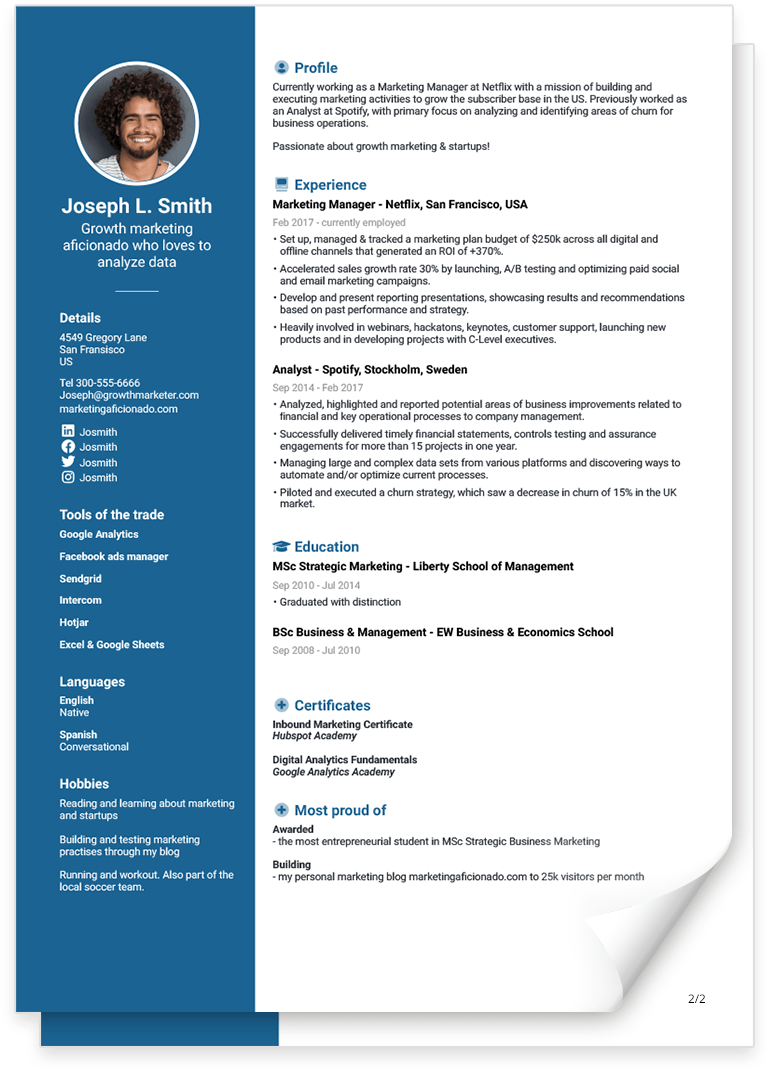
A strong interview starts long before you sit down with a recruiter. Before employers ask questions, they need a reason to invite you in the first place—and that starts with a well-written resume.
Explore our professionally designed resume templates and create a resume that helps you get noticed by recruiters, ATS systems, and AI-powered hiring tools.
Use ChatGPT to improve STAR answers
Many of the most important interview questions are behavioral questions. These questions are designed to assess how you have handled real situations in the workplace and whether you possess the skills and competencies required for the role.
One of the most effective ways to answer behavioral interview questions is by using the STAR method. STAR provides a structured framework that helps you tell clear, concise, and evidence-based stories about your experience.
STAR stands for:
Situation
Describe the context or challenge you faced.
Task
Explain your responsibility or objective in that situation.
Action
Outline the specific actions you took to address the challenge or achieve the goal.
Result
Demonstrate the outcome of your actions, ideally supported by measurable results such as revenue growth, cost savings, improved efficiency, customer satisfaction, or other business impact.
Many candidates struggle with behavioral questions because their answers are either too vague or lack a clear result. ChatGPT can help transform unstructured answers into compelling STAR responses that better demonstrate your value to employers.
Use the following prompt:
"Rewrite my answer using the STAR method and suggest measurable results where appropriate. Act as a recruiter and explain how I can make the answer stronger."
For example, instead of saying:
"I helped improve customer satisfaction in my previous role."
ChatGPT can help you create a stronger STAR response that explains the situation, the actions you took, and the measurable impact you achieved.
This approach not only improves your interview answers but also helps you identify achievements that may be worth adding to your resume or cover letter.
The more specific your examples are, the more credible and memorable your answers become. Recruiters are far more likely to remember candidates who can demonstrate real results than those who rely on generic statements about being motivated, hardworking, or a team player.
Ask ChatGPT to help you answer the questions
Generating interview questions is only the first step. To get real value from ChatGPT, you should also use it to develop and refine your answers.
Many candidates know what they want to say but struggle to communicate their experience clearly and convincingly. ChatGPT can help you structure your thoughts, identify stronger examples from your background, and present your experience in a way that is relevant to the role you are pursuing.
Use the following prompt:
"I would like help answering interview questions for a [job title] position. I will provide one question at a time. Your task is to help me create the strongest possible answer based on my experience. Ask follow-up questions if you need additional information. The first question is: [question]"
Repeat the process for each question you want to prepare for.
The more context you provide, the more valuable the output becomes. Instead of accepting generic responses, share details about your previous roles, achievements, challenges, and responsibilities. This allows ChatGPT to generate answers that are more authentic and tailored to your professional background.
Preparing in this way also helps you reflect on your accomplishments and identify examples that demonstrate key competencies such as leadership, teamwork, problem-solving, communication, adaptability, and decision-making.
Whenever possible, support your answers with specific examples and measurable results. Employers are generally more interested in evidence of past performance than broad statements about your strengths.
Ask ChatGPT to challenge weak answers
One of the most effective ways to prepare for an interview is to actively look for weaknesses in your answers before a recruiter does.
After drafting a response, ask ChatGPT to critique it from the perspective of a hiring manager.
Use this prompt:
"Act as a hiring manager interviewing candidates for a [job title] position. Critique my answer, identify weaknesses, highlight areas that need more detail, and suggest specific improvements."
This approach helps uncover common issues such as:
- Answers that are too vague
- Missing examples or results
- Weak STAR structure
- Lack of business impact
- Failure to address the interviewer's underlying question
By continuously refining your responses through feedback and iteration, you can develop answers that are clearer, more persuasive, and more memorable during the actual interview.
Ask ChatGPT to practice job interviews with you
Knowing how you want to answer interview questions is one thing. Delivering those answers confidently under pressure is something entirely different.
This is why practicing interview scenarios is one of the most effective ways to prepare for a job interview. Just as athletes train before a competition, job seekers should train before an interview. The more familiar you become with answering questions out loud, the more natural and confident your responses will feel during the actual conversation.
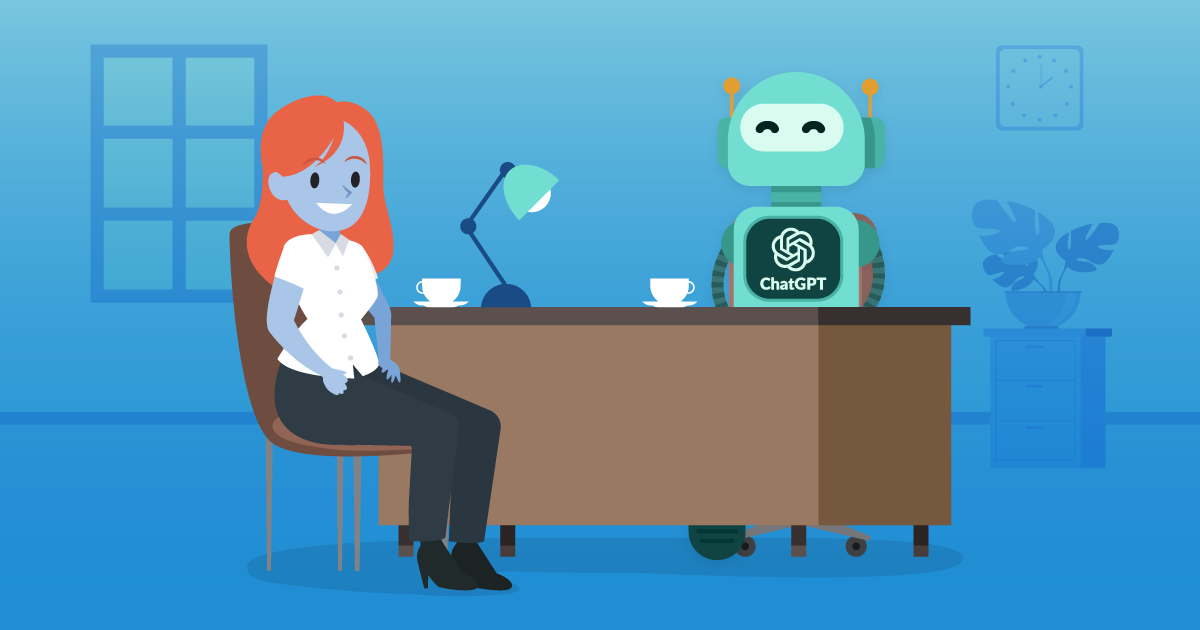
ChatGPT can act as a realistic interview partner, allowing you to simulate interview situations, respond to questions in real time, and practice handling follow-up questions.
Use the following prompt:
"Act as an experienced recruiter interviewing me for a [job title] position. Ask realistic interview questions one at a time, challenge weak answers, ask follow-up questions when appropriate, and provide feedback at the end of the interview."
Unlike simply reading interview questions, a mock interview forces you to think on your feet and communicate your experience in a conversational setting. This helps you identify gaps in your answers, improve your storytelling, and become more comfortable discussing your achievements.
Respond to each question as if you were sitting in a real interview and continue the conversation until the interview is complete.
Ask ChatGPT for feedback on your job interview
One of the biggest advantages of using ChatGPT for interview preparation is the ability to receive immediate feedback after a mock interview.
Once you have completed the practice interview, ask ChatGPT to evaluate your performance and identify areas for improvement. This allows you to refine your answers before speaking with an actual recruiter or hiring manager.
For the most useful feedback, ask ChatGPT to evaluate your responses based on:
- Confidence
- Relevance to the question
- Specificity and examples
- STAR structure
- Communication and clarity
You can also ask ChatGPT to assess the overall quality of the interview and identify recurring weaknesses across multiple answers.
Use the following prompt:
"Act as a hiring manager and evaluate my interview performance. Score each answer for confidence, relevance, specificity, STAR structure, and communication. Identify weaknesses, explain what could be improved, and provide examples of stronger answers where appropriate."
Alternatively, if you want a simpler evaluation, you can remain in the same conversation and ask:
"Can you give me feedback on my interview answers? Which areas should I improve before a real interview?"
This process helps you identify weak examples, vague statements, missing results, or areas where your answers may not clearly demonstrate your value. By incorporating feedback and repeating the exercise, you can steadily improve both the quality of your answers and your overall interview performance.
Common ChatGPT interview mistakes
ChatGPT can be a powerful interview preparation tool, but like any tool, its effectiveness depends on how you use it. Many job seekers make the mistake of treating AI-generated answers as finished products rather than starting points for preparation.
Understanding the most common mistakes can help you get better results from ChatGPT and avoid creating answers that sound generic, scripted, or disconnected from your actual experience.
Memorizing AI-generated answers
One of the biggest mistakes candidates make is memorizing answers word-for-word.
Recruiters and hiring managers are not looking for perfect scripts. They are looking for authentic examples, genuine communication, and evidence of your experience. When answers sound overly rehearsed, they often come across as unnatural and can make it difficult for interviewers to assess your true abilities.
Use ChatGPT to generate ideas and structure your responses, but always make the final answer your own.
Using generic examples
ChatGPT can only work with the information you provide.
If your prompts lack detail, the AI will often generate broad, generic responses that could apply to almost anyone. Generic answers rarely stand out in a competitive interview process.
The strongest interview answers include specific situations, actions, and measurable results from your own career.
Forgetting to personalize responses
Every candidate has a unique background, and every company has unique requirements.
A response that works well for one candidate may not work for another. Before using any AI-generated answer, adapt it to reflect your own experience, achievements, skills, and career goals.
Relying too heavily on AI
ChatGPT should support your preparation, not replace it.
Successful candidates combine AI-generated insights with independent research, self-reflection, and real-world practice. The goal is not to let AI do the thinking for you but to help you prepare more effectively.
Not researching the company
Many candidates spend hours practicing interview questions but very little time researching the employer.
No AI-generated answer can replace a thorough understanding of the company, its products, culture, customers, and industry. Strong candidates combine interview preparation with company research to create answers that are relevant to the specific role and organization.
Limitations of ChatGPT for interview preparation
While ChatGPT is a valuable interview preparation tool, it is important to understand its limitations.
ChatGPT does not have access to:
- Your complete career history
- The company's internal culture
- The hiring manager's preferences
- Internal hiring criteria
- The actual interview questions you will be asked
As a result, its recommendations should be viewed as guidance rather than certainty.
ChatGPT can help you prepare stronger answers, identify potential weaknesses, and practice interview scenarios, but it cannot predict exactly how an interview will unfold. The quality of its output also depends heavily on the quality of the information you provide.
The most effective approach is to treat ChatGPT as a personal interview coach rather than a replacement for preparation. Use it to challenge your thinking, improve your answers, and refine your communication skills—but always combine AI-generated guidance with your own experience, research, and judgment.
Can recruiters tell if you used ChatGPT?
In most cases, recruiters cannot tell whether you used ChatGPT to prepare for an interview.
Using ChatGPT for interview preparation is no different from using interview guides, career coaches, online courses, or practice exercises. Employers generally care about your ability to perform in the role, not the tools you used to prepare.
However, recruiters can often identify answers that sound overly scripted, generic, or memorized.
Best AI tools for interview preparation
While ChatGPT is one of the most popular AI tools for interview preparation, it is not the only option available. Different AI assistants have different strengths, and many job seekers use multiple tools throughout the application and interview process.
The best choice depends on your goals. Some tools excel at mock interviews and answer refinement, while others are particularly useful for research, analysis, or reviewing lengthy responses.
Here is an overview of some of the most widely used AI tools for interview preparation in 2026:
| AI Tool | Best For |
|---|---|
| ChatGPT | Mock interviews, interview practice, answer refinement, and feedback |
| Gemini | Company research, industry insights, and information discovery |
| Claude | Improving long-form answers and refining detailed responses |
| Perplexity | Research, fact-checking, and gathering up-to-date information |
| Copilot | Interview preparation within the Microsoft ecosystem and productivity workflows |
Ultimately, the best interview preparation strategy is not choosing the "best" AI tool—it is using whichever tool helps you communicate your experience, skills, and achievements more effectively during the interview.
Use ChatGPT for other parts of your job search
Interview preparation is just one of many ways ChatGPT can support your job search. When used strategically, AI can help you throughout the entire application process—from identifying opportunities and refining application materials to preparing for interviews and evaluating career options.
Many successful job seekers now use ChatGPT as a personal career assistant to help them communicate their experience more effectively and make better-informed career decisions.
For example, ChatGPT can help with:
- Resume optimization
- Cover letter writing
- LinkedIn profile improvement
- Career changes and transferable interpersonal skills
- Skills analysis and gap identification
- Job matching and role evaluation
- Interview preparation
- Salary negotiation preparation
- Professional networking outreach
However, the most successful candidates are not replacing preparation with AI. They are using AI to prepare more effectively.
ChatGPT can help you identify weaknesses in your application, strengthen your interview answers, improve confidence, refine your communication, and uncover opportunities for improvement. What it cannot do is replace your experience, achievements, judgment, or personality.
Every statement included in your resume, cover letter, LinkedIn profile, or interview answers should accurately reflect your background and be something you can confidently discuss with an employer.
The job seekers who get the most value from AI are those who combine it with genuine self-reflection, research, and professional experience.
As AI continues to reshape recruitment and hiring, learning how to use tools like ChatGPT effectively is becoming an increasingly valuable career skill. The candidates who understand how to combine human expertise with AI-assisted preparation often gain a significant advantage in today's competitive job market.
Of course, none of this matters if you are not getting invited to interviews in the first place.
Your resume remains the foundation of your job search. It is often the first thing recruiters, hiring managers, and AI-powered screening systems evaluate when deciding whether to move a candidate forward.
Ready to create a professional resume that helps you get more interviews?

![The Best CV Format For Freshers [examples]](https://jofibostorage.blob.core.windows.net/blog/the-best-cv-format-for-freshers-header.png)